Getting started
Set up keepers and keeper prices
Keepers are two jobs that get confused with each other: telling RotoAlpha what your league's carry-over rules are, and recording which players are actually being kept this year. Rules live in settings. Assignments are made on the Keepers page, next to the numbers you make them on.
Step 1: the rules
Open Settings in the left sidebar, then Season Settings, then the Keepers card. Start with the system:
- Re-draft: nothing carries over. Nothing else to configure.
- Keeper: teams hold a limited number of players year to year.
- Dynasty: rosters persist, with a farm system and a rookie draft. You set the farm size and how many rookie rounds you run. RotoAlpha records dynasty rules, rosters, and history, but the live draft room does not run rookie drafts yet.
For a keeper league, set the max keepers per team, then the cost mechanic, which is where leagues differ most.
Cost mechanics in an auction league
- Discount: the price falls each year you hold the player. A $20 keeper costs $19 next year, $18 the year after.
- Inflation: the price rises instead. A $20 keeper costs $21 next year, $22 the year after.
- Same price: the keeper price never moves.
- Keeper auction (right of first refusal): kept players go back on the block, and the incumbent can match. You set what discount the incumbent gets on the overage and how that discount rounds. Rounding up favors the keeping manager, rounding down favors the other bidders, and rounding to nearest is neutral.
Cost mechanics in a snake or linear league
- Round-up (with discount): the keeper costs a pick some fixed number of rounds earlier, every year. At a discount of 2, a 5th-round keeper costs a 3rd-round pick.
- Sliding round: the cost climbs each year held. A 10th-round keeper at a step of 1 costs a 9th-round pick in the first year of keeping, an 8th in the second, a 7th in the third.
- Same round: the cost stays at the round they were drafted in.
- Free: keeping costs no pick at all.
You can also set a minimum keeper price and a maximum number of consecutive years a player may be kept. Leave the year cap at 0 for unlimited. RotoAlpha flags a keep that would breach the cap rather than blocking it, because leagues grant exceptions and the app should not argue.
Step 2: decide who is worth keeping
Choose Keepers in the left sidebar. It takes last season's rosters, applies your keeper rules to work out what each player would cost this year, and puts that next to what RotoAlpha projects the player to be worth.
Rosters are grouped by team. In an auction league under a right-of-first-refusal system the columns read Declare $ (what opens the bidding), Match $ (what the player costs you if he goes for his projection) and Value (the surplus that buys), with the projected rank and projected dollars in between, and Kept counting the years he has already been held. Under the simpler mechanics the declared price is what you pay, so Match and Declare agree.
A snake or linear league reads the same table in rounds, because a keeper there
costs a pick rather than a price. Drafted R is the round last season spent
on him and Keeper R is the round he costs to keep. Proj Rank shows where
this season's board has him with the round it implies in brackets, so a player
reading #18 (R2) is a second-round pick on your board. Value is the
difference between those two rounds: keep a round-2 player for a round-6 pick
and the row reads +4 rds. A player the board ranks below the last pick your
draft makes reads undrafted, because no round in it would buy him.
Filter to one team, or press Good Values to hide everything except the players worth keeping. Export CSV takes the table with you.
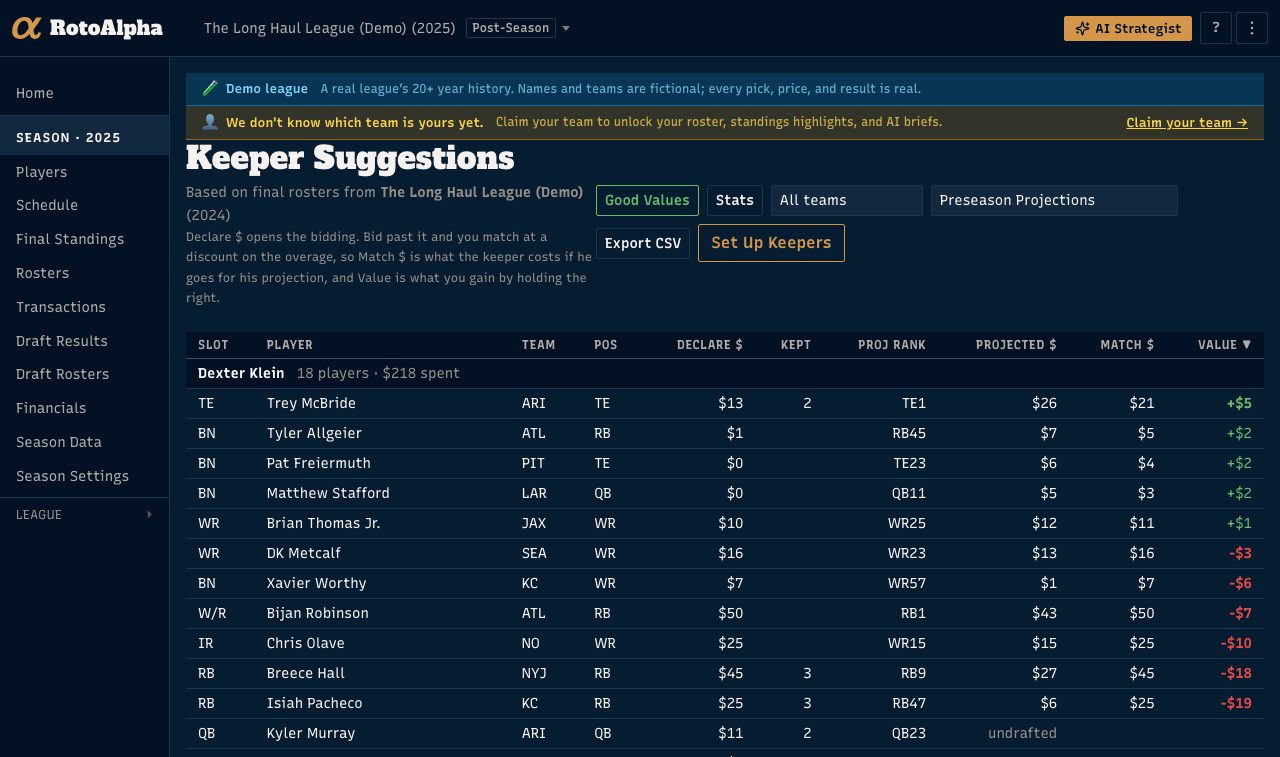
Two things make this page work properly: a previous season must be imported (see import your league's history), and a projection set for the upcoming year must be loaded, or the page will tell you it is showing last year's numbers instead. See upload your own projections.
Step 3: record the assignments
While the season's phase is Pre-Draft or Keeper-Draft, every row on the Keepers page carries a Keep button in the last column. Press it and that player is kept by that team at the cost your rules imply, so the whole league's declarations go in from one screen as the list comes round.
The button then reads Kept with the price (or the round, in a snake league). Click it to correct the number by hand when your league grants an exception, or Undo to release the player. Each team's header counts how many it has kept so far.
A row that cannot be declared says why instead of offering the button: the player is not in this season's pool, his old team has no seat this season, or a snake league has no round on record to carry forward. That last one is fixable on the Players page, where you can set the round by hand.
The Players page carries the same assignments with more detail around them, and is where you correct how many straight years a player has been held. It is reachable from the Set Up Keepers button. In Pre-Draft the player table grows three keeper columns:
- Prev Manager, who rostered the player last season.
- Keeper, the manager keeping the player this year.
- Keep $, what keeping them costs, and Keep Δ, that cost against the player's projected value. A positive delta is a bargain. A snake or linear league reads these as Keep R and a delta in rounds instead.
Press Keep on a player and RotoAlpha assigns them to their previous manager at the cost your rules imply. If nothing is set yet, the suggested price or round shows in italics so you can see what it would be before you commit to it.
Opening a player in a snake or linear league gives you a Keeper Round box next to Kept By. It arrives filled in with the round he would carry forward, and you can type over it whenever your league grants an exception or you disagree with the number. It is also how you handle a keeper the suggestion cannot price at all: a player with no previous-season row, or one whose row recorded no round, has nothing to carry forward, so type the round your league agreed and the declaration is complete.
Once assigned, the player carries a line reading who is keeping them, at what price or round, how long they have been held, and what they would cost next year.
Why this is worth doing carefully
Keeper assignments are league-public. Your league-mates see who is kept and at what price on the public draft page, because it is their draft too and they need to know which players are off the board. Your private notes and your projected values stay private. See share the public draft page.
They also feed the manager profiles: how many players a manager holds, how long they hold them, and at which positions is one of the tendencies the report tracks.